The universe is filled with particles of extraordinary energies, witnesses to the most violent and energetic phenomena in the cosmos.
Among these cosmic messengers, gamma rays hold a special place: they are the most energetic photons
in the universe, capable of revealing to us the secrets of black holes, supernovas, and pulsars.
Unlike visible light rays that our eyes can perceive, gamma rays are invisible but carry crucial information
about particle acceleration processes and the extreme conditions prevailing in space. To detect them from Earth,
we use an ingenious technique that turns our atmosphere into a gigantic detector:
atmospheric Cherenkov telescopes.
⚡ Gamma Rays: Messengers of the Extreme
What is a gamma ray?
A gamma ray is a very high-energy photon, a member of the electromagnetic radiation family that also includes
visible light, X-rays, and radio waves. Gamma rays are distinguished by their exceptional energy:
Frequency: higher than 30 exahertz (3×10¹⁹ Hz)
Wavelength: less than 10 picometers
Energy: from a few kiloelectronvolts (keV) to several teraelectronvolts (TeV)
Speed: that of light (300,000 km/s)
Cosmic sources of gamma rays
🌟 Pulsars and Magnetars
Pulsars are rapidly rotating neutron stars with intense magnetic fields.
They emit beams of gamma rays along their magnetic poles, creating a “cosmic lighthouse” effect.
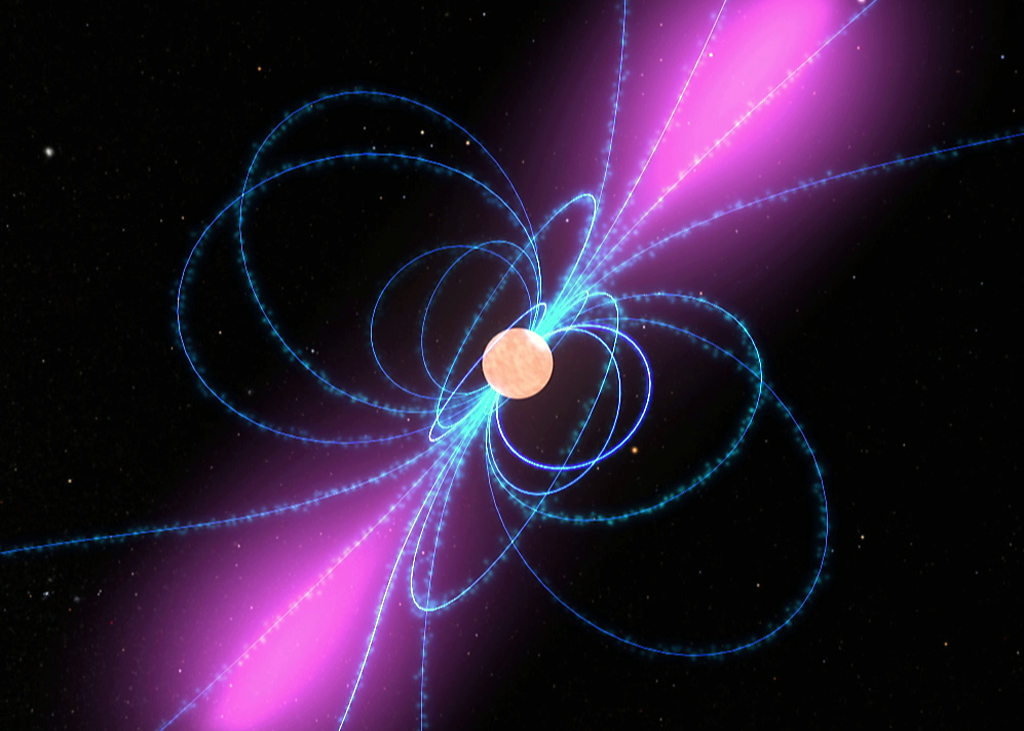
Illustration of a pulsar. Credit: NASA.
🕳️ Active Black Holes
Supermassive black holes at the centers of active galaxies accelerate particles to relativistic speeds,
producing gamma-ray jets extending over thousands of light-years.
Relativistic jet of M87 seen by Hubble. Credit: NASA/ESA/Hubble.
💥 Supernovas and Hypernovas
The explosion of massive stars at the end of their life releases enormous amounts of energy in the form of gamma rays,
particularly during gamma-ray bursts, the most energetic phenomena in the universe.
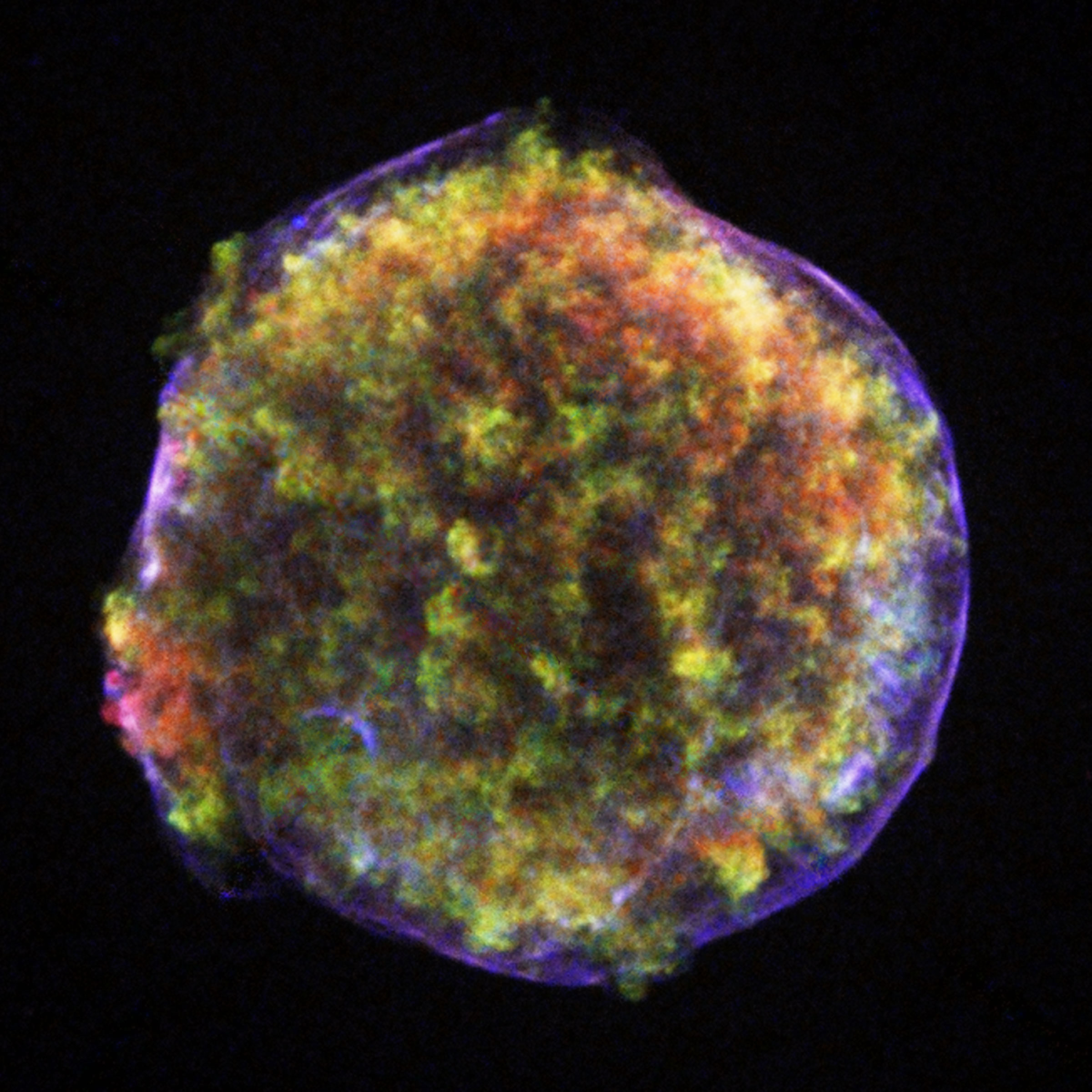
Remnant of Tycho’s supernova (X). Credit: NASA/CXC.
💥 Gamma-Ray Bursts
Gamma-ray bursts (GRBs) are the most powerful explosions in the universe, releasing in a few seconds the energy the Sun will produce in 10 billion years. They are associated with the formation of black holes or neutron stars.
Illustration of a gamma-ray burst. Credit: ESO
💥 Star-Forming Environments
Star-forming environments are massive stellar nurseries. Supernova explosions occurring there accelerate particles to extreme energies, producing gamma rays.
Image of the galaxy Messier 82. Credit: CTAO
Why study gamma rays?
Gamma rays allow us to study the most extreme phenomena of the universe because they:
Travel in straight lines from their source (unlike charged cosmic rays deflected by magnetic fields)
Preserve information about their origin and energy
Reveal particle acceleration processes at energies unattainable on Earth
Inform us about physics under extreme conditions of temperature, density, and magnetic field
🌧️ Atmospheric Showers: Particle Cascades
The phenomenon of atmospheric showers
When a very high-energy cosmic particle (gamma ray, proton, or atomic nucleus) enters the Earth's atmosphere, it generally cannot reach the ground directly.
At an altitude of 10 to 20 km, it interacts with the nuclei of atmospheric molecules and
triggers a particle cascade called an atmospheric shower.
Types of atmospheric showers
Electromagnetic showers (gamma rays)
Pair production: The primary gamma ray interacts with the electric field of an atmospheric nucleus
and transforms into a very high-energy electron-positron pair.
Bremsstrahlung: These ultra-relativistic charged particles emit secondary gamma rays through bremsstrahlung.
Cascade multiplication: These new gamma rays in turn produce new pairs,
creating an exponential cascade of particles.
Hadronic showers (protons and nuclei)
Strong interaction: The primary proton or nucleus undergoes a nuclear collision
with an atmospheric nucleus, producing mesons (pions, kaons).
Pion decay: Neutral pions quickly decay into gamma rays,
triggering electromagnetic sub-showers. Charged pions produce muons.
Multiple cascades: The nuclear fragments continue interacting,
creating a chaotic development with multiple sub-showers.
Common characteristics
Shower maximum: Showers reach their maximum development around 5–15 km altitude,
potentially containing up to 10 billion particles!
Gradual absorption: The energy disperses progressively in the atmosphere,
and the cascade dissipates before reaching the ground.
Characteristics of gamma-ray vs proton showers
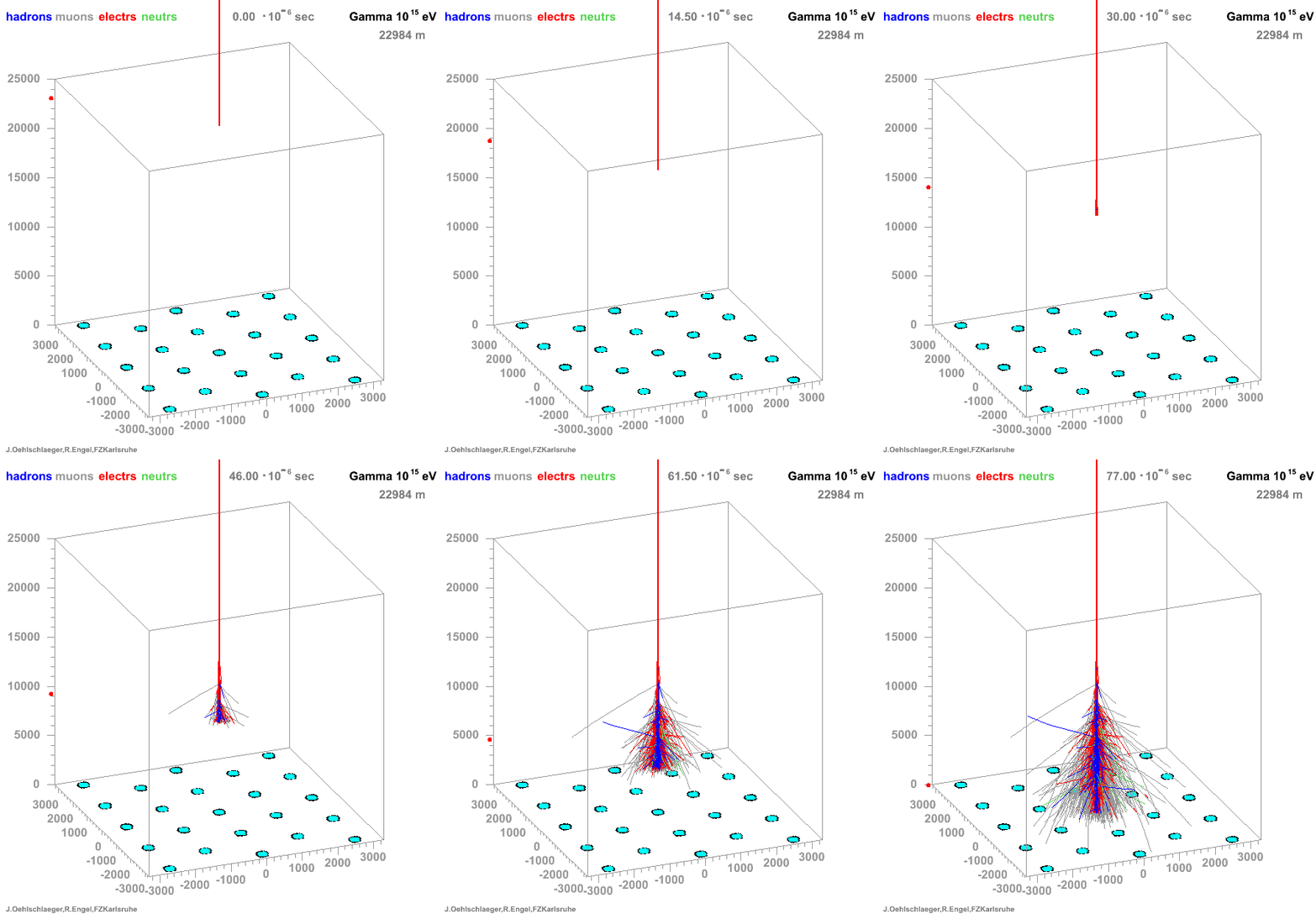
🌟 Gamma-Ray Showers
Shape: Compact and symmetric
Particles: Mainly electrons/positrons and photons
Development: Fast and predictable
Width: ~100–200 meters on the ground
Profile: Pronounced central concentration
Simulation of a gamma-ray shower
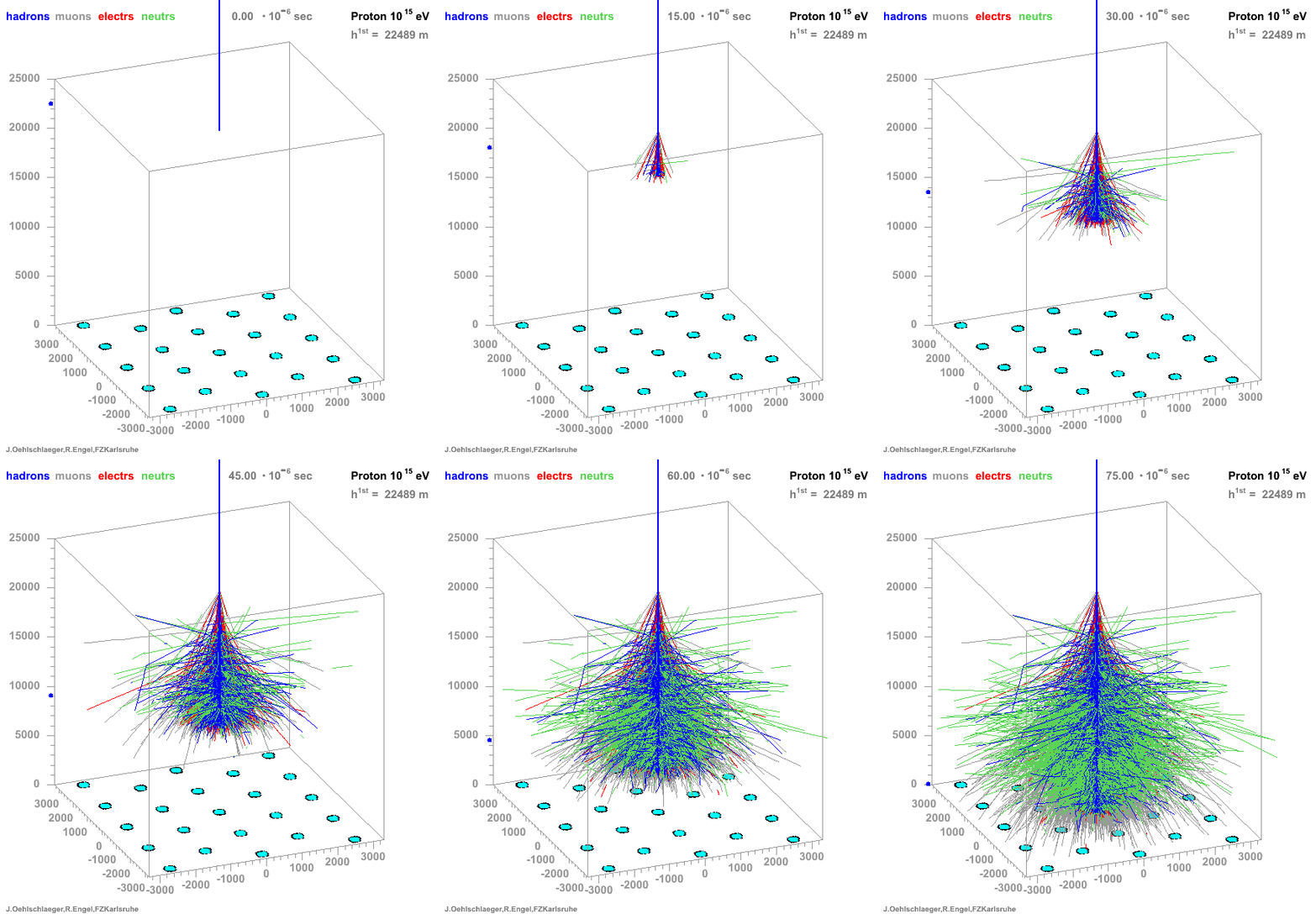
⚛️ Proton Showers
Shape: Irregular and asymmetric
Particles: Muons, pions, various hadrons
Development: Chaotic with sub-showers
Width: ~300–500 meters on the ground
Profile: More diffuse distribution
Simulation of a proton shower
This fundamental difference in shower development is the basis for discriminating
between gamma rays and proton cosmic rays—a major challenge in gamma astronomy.
💎 The Cherenkov Effect: Blue Flash in the Atmosphere
Discovery and principle
The Cherenkov effect, discovered by Russian physicist Pavel Cherenkov in 1934, occurs when a charged particle
travels through a medium at a speed greater than the light speed in that medium. In the atmosphere,
this produces a characteristic blue flash of light.
Physical mechanism
When the electrons and positrons from the atmospheric shower travel through air at speeds close to the speed of light
in a vacuum (but faster than the light speed in air), they emit Cherenkov radiation:
Spectrum: Continuous, dominated by blue–UV
Geometry: Light cone with an opening angle of about 1°
Duration: 5 to 20 nanoseconds (an ultra-brief flash!)
Intensity: Proportional to the energy of the primary gamma ray
Illuminated area: Circle of 100–300 meters in diameter on the ground
Unique properties for detection
Cherenkov radiation exhibits ideal characteristics for detecting gamma rays:
It preserves the directional information of the primary gamma ray
Its intensity is proportional to energy
Its brevity allows to distinguish it from background noise
Its polarization can reveal information about cosmic magnetic fields
💎 The Cherenkov Effect: Blue Flash in the Atmosphere
Discovery and principle
The Cherenkov effect, discovered by the Russian physicist Pavel Cherenkov in 1934, occurs when a charged particle
travels through a medium faster than the speed of light in that same medium. In the atmosphere,
this generates a characteristic blue light flash.
Physical mechanism
When the electrons and positrons from the atmospheric shower traverse the air at speeds close to the speed of light
in a vacuum (but higher than the speed of light in air), they emit Cherenkov radiation:
Spectrum: Continuous, dominated by blue–UV
Geometry: Light cone with an opening angle of about 1°
Duration: 5 to 20 nanoseconds (an ultra-brief flash!)
Intensity: Proportional to the energy of the primary gamma ray
Illuminated area: Circle 100–300 meters in diameter on the ground
Unique detection properties
Cherenkov radiation has ideal characteristics for detecting gamma rays:
It preserves the directional information of the primary gamma ray
Its intensity is proportional to the energy
Its brevity enables discrimination from background noise
Its polarization can reveal information about cosmic magnetic fields
🔭 CTA: The Cherenkov Telescope Array
A revolution in gamma-ray astronomy
The Cherenkov Telescope Array (CTA) represents the next generation of observatories
dedicated to very-high-energy gamma-ray astronomy. This ambitious international project aims to revolutionize
our understanding of the high-energy universe.

Sites and architecture
Locations of the CTA arrays. Credit: CTAO.
🌍 Northern Site (La Palma, Spain)
4 LST telescopes (Large Size, 23 m) – low energies
15 MST telescopes (Medium Size, 12 m) – medium energies
Coverage: 20 GeV – 300 TeV
Target: Extragalactic sources, AGN
🌎 Southern Site (Paranal, Chile)
4 LST telescopes (Large Size, 23 m)
25 MST telescopes (Medium Size, 12 m)
70 SST telescopes (Small Size, 4–6 m) – high energies
Target: Galactic center, galactic sources
Expected performance
Sensitivity: ~10× better than current instruments
Angular resolution: ~2–3 arcmin
Energy coverage: 20 GeV → 300 TeV
Reaction time: < 30 s to reposition
Scientific goals
🎯 Expected discoveries
Mapping the galactic center
Studying cosmic accelerators
Searching for dark matter
Fundamental physics tests
Gamma-ray bursts and multi-messenger observations
🔬 Fundamental questions
Origin of cosmic rays
Nature of dark matter
Lorentz invariance violation
Jet formation and evolution
Black hole physics
🎯 Detection and Analysis Techniques
When a shower illuminates the ground, each telescope in the array (LST/MST/SST) captures this blue flash with its large mirror and focuses it onto an ultra-fast camera.
Stereoscopy Principle
Using multiple telescopes observing simultaneously the same atmospheric shower enables precise reconstruction of its characteristics:
Triangulation: Precise determination of the arrival direction
3D Geometry: Reconstruction of the spatial development of the shower
Discrimination: Efficient gamma/hadron separation
Cross calibration: Mutual validation of measurements
Artificial Intelligence and Machine Learning
Artificial intelligence is now widely used by Cherenkov telescopes to automatically analyze images of atmospheric showers. These algorithms enable event classification (distinguishing gamma rays from protons) and reconstruction of the primary particle’s direction and energy from the observed image patterns.
Projects such as GammaLearn develop machine learning techniques specifically tailored for gamma-ray astronomy, significantly improving detection performance.
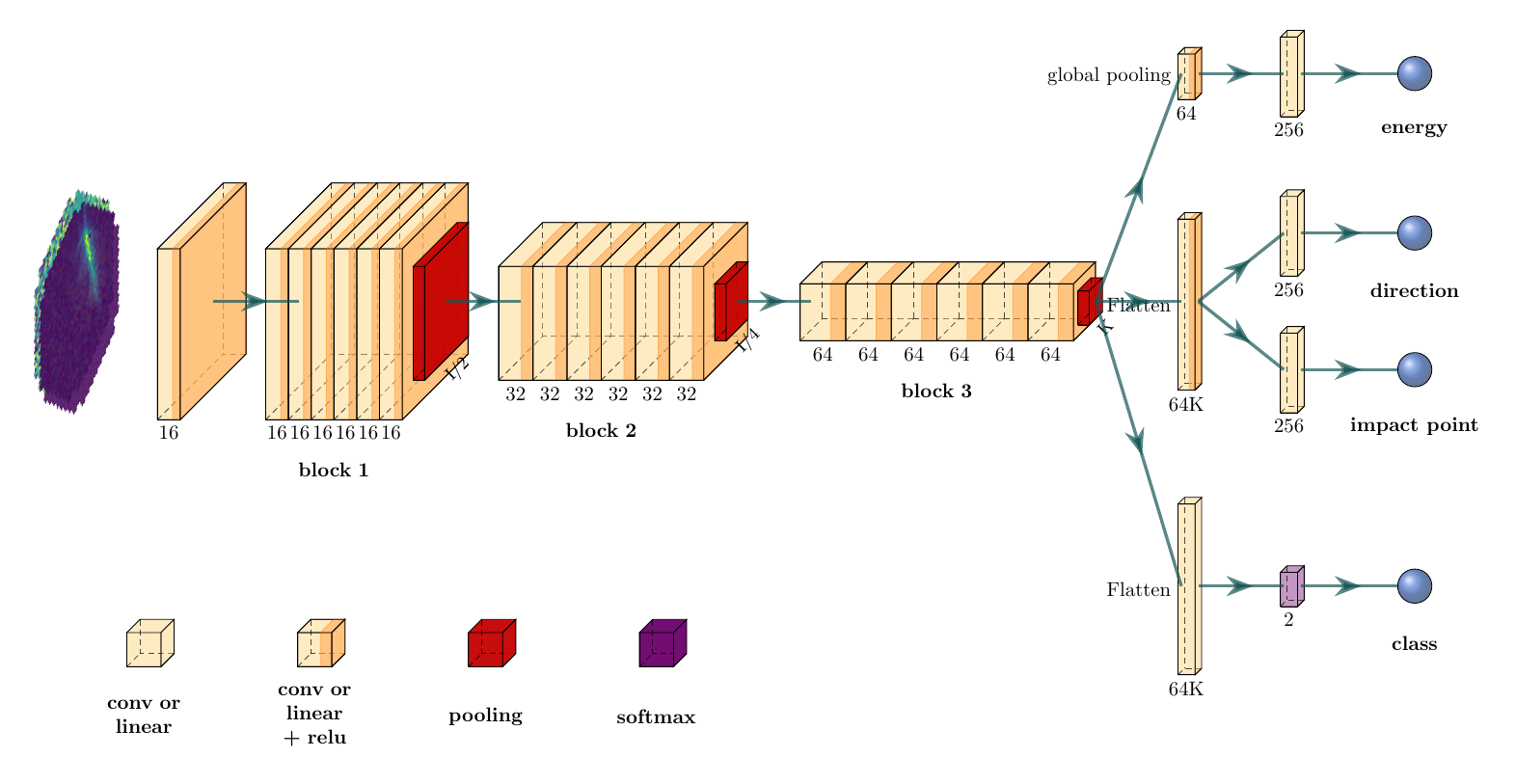
Architecture of the GammaPhysNet network: input are images from Cherenkov telescopes; output is the particle type (gamma or hadron) that produced the image, along with its direction and energy.
This is exactly the kind of analysis you practice in The Gamma Game, learning to distinguish the characteristic signatures of gamma rays from those of cosmic protons!
🚀 Challenges and Future Outlook
Current Technical Challenges
Cosmic background noise: 99.9% of detected events are protons
Weather conditions: Influence of clouds, humidity, dust
Light pollution: Interference with nighttime observation
Detector aging: Degradation of photomultipliers
Calibration: Maintaining accuracy over long periods
Future Scientific Impact
The next decades of gamma-ray astronomy promise revolutionary discoveries:
Multi-messenger astronomy: Coordination with gravitational waves and neutrinos
3D mapping: Detailed structure of our galaxy
Exotic physics: Tests of quantum gravity theories
New Standard Model: Unknown particles and interactions
🎮 From Science to Game
Now that you understand the fascinating science behind gamma-ray detection, you can fully appreciate the challenge posed by The Gamma Game!
Each image you classify in the game corresponds to a genuine Cherenkov observation. By learning to distinguish gamma-ray showers from cosmic proton showers, you reproduce the daily work of astrophysicists analyzing data from H.E.S.S., MAGIC, VERITAS—and soon CTA.
The main challenge of modern gamma-ray astronomy is to analyze physically complex images quickly and with great precision, to extract reliable scientific information about the universe’s most energetic phenomena.